Electronic Funds Transfer: Cut Business Transaction Costs | DeeMoney

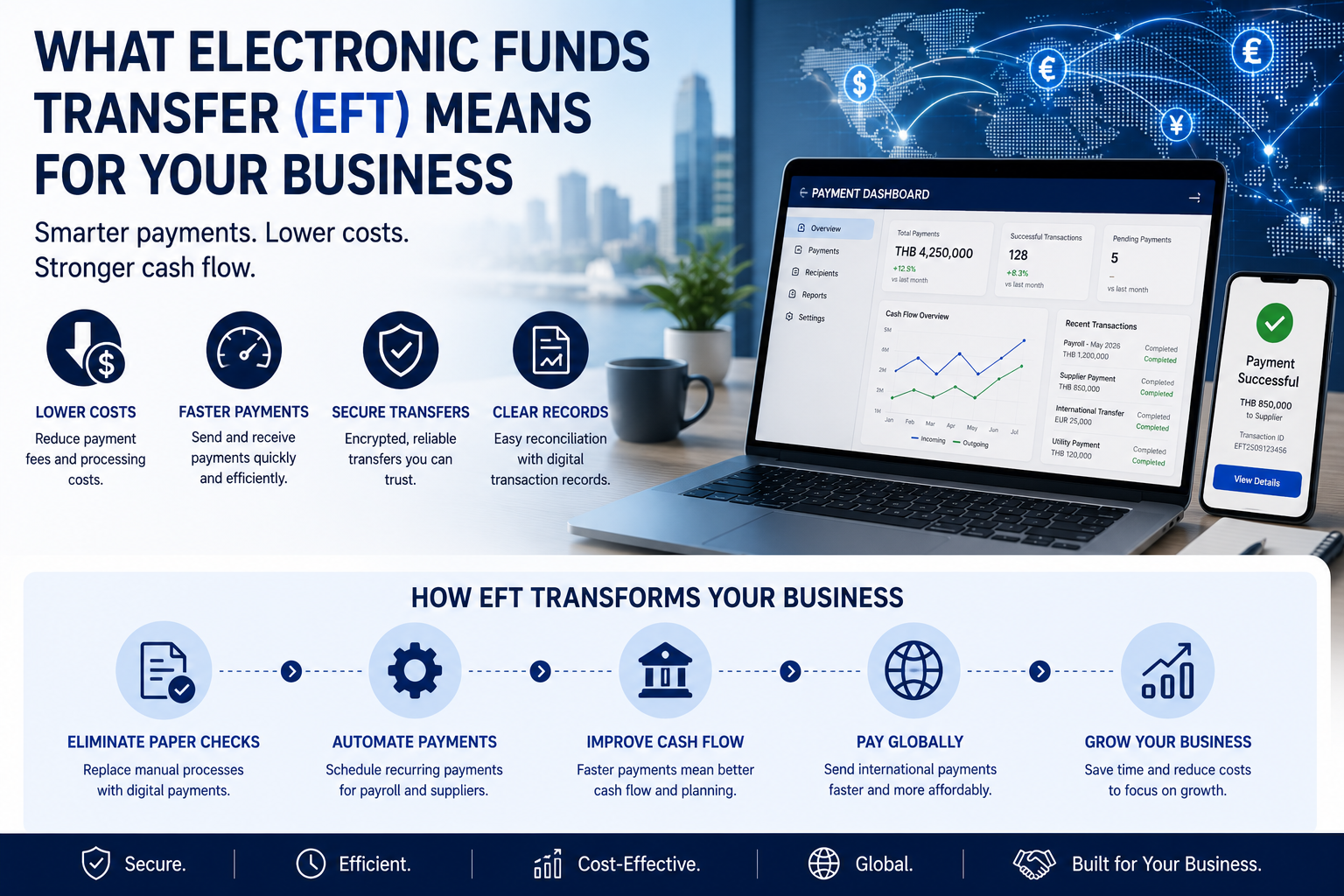
What Electronic Funds Transfer Means for Your Business
Every baht your business spends on extra transaction fees is money that could be invested in growth, hiring, or operations. In 2026, these fees silently drain thousands from your bottom line each year.
Electronic funds transfer (EFT) is the digital transfer of money between bank accounts through secure networks. This method eliminates paper checks, manual steps, and waiting in line at the bank. Transactions occur electronically from start to finish, with a clear digital record at each step.
For businesses in Thailand — whether you're paying overseas suppliers, handling payroll, or settling invoices — EFT is more than a convenience; it's a strategic financial choice. Businesses using EFT in 2026 spend less per transaction and move money faster. Those still relying on traditional methods pay the price.
The Real Cost of Traditional Payment Methods in 2026
Paper checks are more expensive than many business owners realize. When you consider printing, postage, manual work, and staff time for handling payments, one check can cost your business $4 to $20. Multiply that by hundreds of transactions each month, and the costs quickly escalate.
Cash payments have their own issues, such as the risk of theft, counting mistakes, and the lack of a digital record for accounting.
Credit card payments might seem convenient, but merchant fees typically range from 1.5% to 3.5% per transaction. For a business handling $50,000 monthly, that's up to $1,750 lost in fees.
In 2026, sticking with these methods is not just old-fashioned—it’s costly. EFT addresses these issues, offering faster, cheaper, and more reliable digital transactions.
How Electronic Funds Transfer Works Step by Step
EFT moves money digitally between bank accounts. Here’s how it works:
- Start – The sender initiates a payment through online banking or a mobile app.
- Check – The bank verifies the sender's identity using secure methods.
- Send – Payment details travel through secure networks like ACH or SWIFT.
- Verify – Both banks confirm the transaction details and available funds.
- Transfer – Money moves from the sender's account to the recipient's account.
- Record – A unique transaction ID is created for both parties to keep.
This process can take from a few minutes to three business days, depending on the transfer type. Many systems now process payments much faster than they did five years ago.
Types of Electronic Funds Transfer and Which One Saves You More
Not all EFT methods cost the same. Choosing the right one directly affects your business's payment expenses.
ACH Transfers are ideal for recurring payments like payroll and vendor invoices. They have low or no fees and usually settle in one to three business days. For frequent, regular transactions, ACH offers significant savings.
Wire Transfers move money quickly, sometimes the same day, but they have higher fees, ranging from $10 to $50 per transaction. Use them for urgent, high-value payments.
Debit and Credit Card Payments process instantly but incur merchant fees that can accumulate over time.
Direct Deposits are perfect for payroll, reducing manual processing costs.
In 2026, businesses that choose the right EFT type for each transaction will retain more money in their accounts.
Key Ways EFT Cuts Down Your Transaction Costs
EFT significantly reduces transaction costs by eliminating expenses associated with paper checks, such as printing, postage, and manual processing.
Automation is a major benefit. Automated payments eliminate the need for manual processing, reducing errors and the costs associated with correcting them.
International transfers through traditional banks often come with high fees and poor exchange rates. EFT-based cross-border payments in 2026 are much cheaper and faster.
Recurring payments like rent, supplier invoices, and payroll become predictable and low-cost with EFT. No late fees, no bounced checks, no administrative hassle.
In short, every payment you switch to EFT directly lowers your operating costs.
Security and Compliance You Cannot Ignore
EFT is not only about saving money but also about protecting it.
Each EFT transaction uses encrypted networks with layered authentication, significantly reducing the risk of fraud compared to paper checks, which can be easily altered or stolen.
In 2026, businesses face stricter financial compliance rules. The Electronic Fund Transfer Act (EFTA) sets the legal guidelines for processing transactions, resolving errors, and ensuring protections for consumers and businesses.
Each transaction creates a unique ID, providing a clear audit trail. This makes reconciliation faster and compliance reporting easier.
For businesses handling cross-border payments, this security is crucial. Funds move through regulated networks, reducing the risk of fraud at every step.
How DeeMoney Makes Electronic Funds Transfer Work for You
In 2026, DeeMoney simplifies cross-border money transfers, especially to and from Thailand. Whether you pay overseas suppliers, manage payroll for international staff, or settle invoices in foreign currencies, DeeMoney offers a faster and cheaper way to move money. You can learn more about our money transfer services for businesses and how they can benefit your operations.
The platform is transparent, with no hidden fees or confusing exchange rate markups. You know exactly what you pay before confirming any transfer. For those interested in currency exchange, check out our currency exchange services for competitive rates.
DeeMoney supports businesses that need reliable, regulated transfers without the delays and high costs of traditional banks in 2026. Transfers use secure networks, keeping your money and data safe at every step. If you're looking for partnership opportunities, visit our partners page to explore how we can work together.
For businesses focused on cutting transaction costs and improving cash flow, DeeMoney is the simple solution designed for these needs. You can also download our trusted instant money transfer app to experience seamless transactions firsthand.
FAQs
1. What is an electronic funds transfer and how does it work?
An electronic funds transfer moves money between bank accounts through secure digital networks. The sender initiates the transfer, the bank verifies the details, and the funds are deposited into the recipient's account — all without paper.
2. How much can a business save by switching to EFT in 2026?
Businesses can save significantly by avoiding check printing, manual work, and high wire fees. EFT methods like ACH have low fees compared to traditional methods.
3. Is electronic funds transfer secure?
Yes. EFTs use encryption, multi-factor authentication, and secure banking networks to ensure transaction safety.
4. How long does an electronic funds transfer take?
Processing times vary. ACH transfers take 1-3 business days, while wire transfers can settle the same day.
5. Can small businesses use electronic funds transfer?
Yes. EFT is cost-effective, easy to set up, and works well for payroll, supplier payments, and recurring invoices. For more information on how we can assist small businesses, visit our business page.